RNA Modifications: How the Epitranscriptome Adds Another Layer of Information
The Epitranscriptome: RNA Beyond the Sequence
RNA molecules are not defined by sequence alone. Chemical modifications add another layer of information that can influence RNA structure, stability, localization, translation, and interaction with cellular machinery.
A second layer of
RNA information.
RNA is often introduced as a sequence of nucleotides that transfers, regulates, or expresses biological information. Yet mature RNA molecules can also contain a large collection of chemical modifications.
These modifications create what researchers describe as the epitranscriptome: a dynamic layer of information superimposed on RNA sequence and structure.
Understanding this layer requires connecting chemistry, RNA biology, analytical technologies, sequencing, computation, and cellular context.
RNA Carries More Than a Sequence
The four canonical RNA bases provide the foundation for genetic information, but biological RNA is chemically more diverse than A, U, G, and C alone.
The primary information layer
Nucleotide sequence determines coding information, regulatory motifs, binding sites, and many of the structural possibilities available to an RNA molecule.
A chemical information layer
Chemical modifications can alter base-pairing, molecular recognition, stability, structure, translation, and interactions with RNA-binding proteins.
The epitranscriptome adds chemical context to RNA.
Instead of treating RNA as a static sequence, epitranscriptomics investigates how chemical changes can dynamically influence the behavior of RNA molecules inside cells.
The Epitranscriptome Expands the RNA Alphabet
More than one hundred chemically distinct RNA modifications have been described across biological systems. Some have become major subjects of modern RNA research.
| Modification | Common context | Biological relevance |
|---|---|---|
| m6A | mRNA and regulatory RNA | RNA stability, translation, processing and molecular recognition |
| Pseudouridine (Ψ) | rRNA, tRNA and mRNA | RNA structure, stability and decoding properties |
| m5C | tRNA, rRNA and mRNA | RNA stability, structure and molecular interactions |
| m1A | tRNA, rRNA and selected mRNA | Base pairing, translation and RNA structure |
| m7G | RNA and transcript processing | RNA stability, processing and molecular recognition |
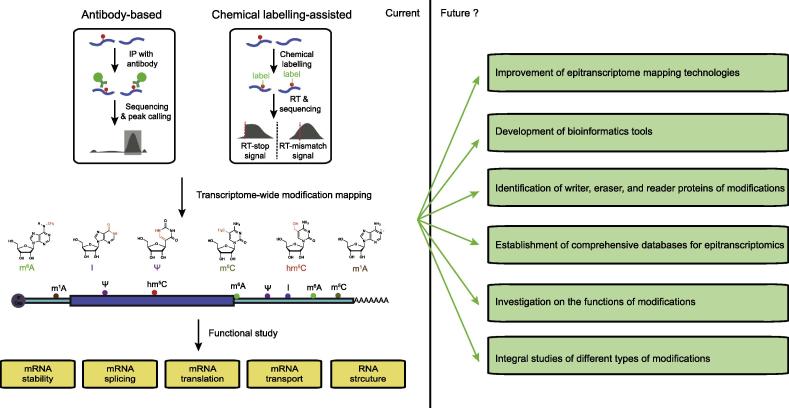
Writers, Readers and Erasers
RNA modifications are not simply permanent chemical decorations. Many are installed, interpreted, and removed through molecular systems that create dynamic regulation.
Installation
Writer enzymes or modifying complexes introduce specific chemical modifications onto RNA molecules.
Recognition
Reader proteins recognize modified RNA and connect the modification with downstream molecular processes.
Removal
Eraser enzymes can remove selected modifications, allowing RNA modification states to change over time.
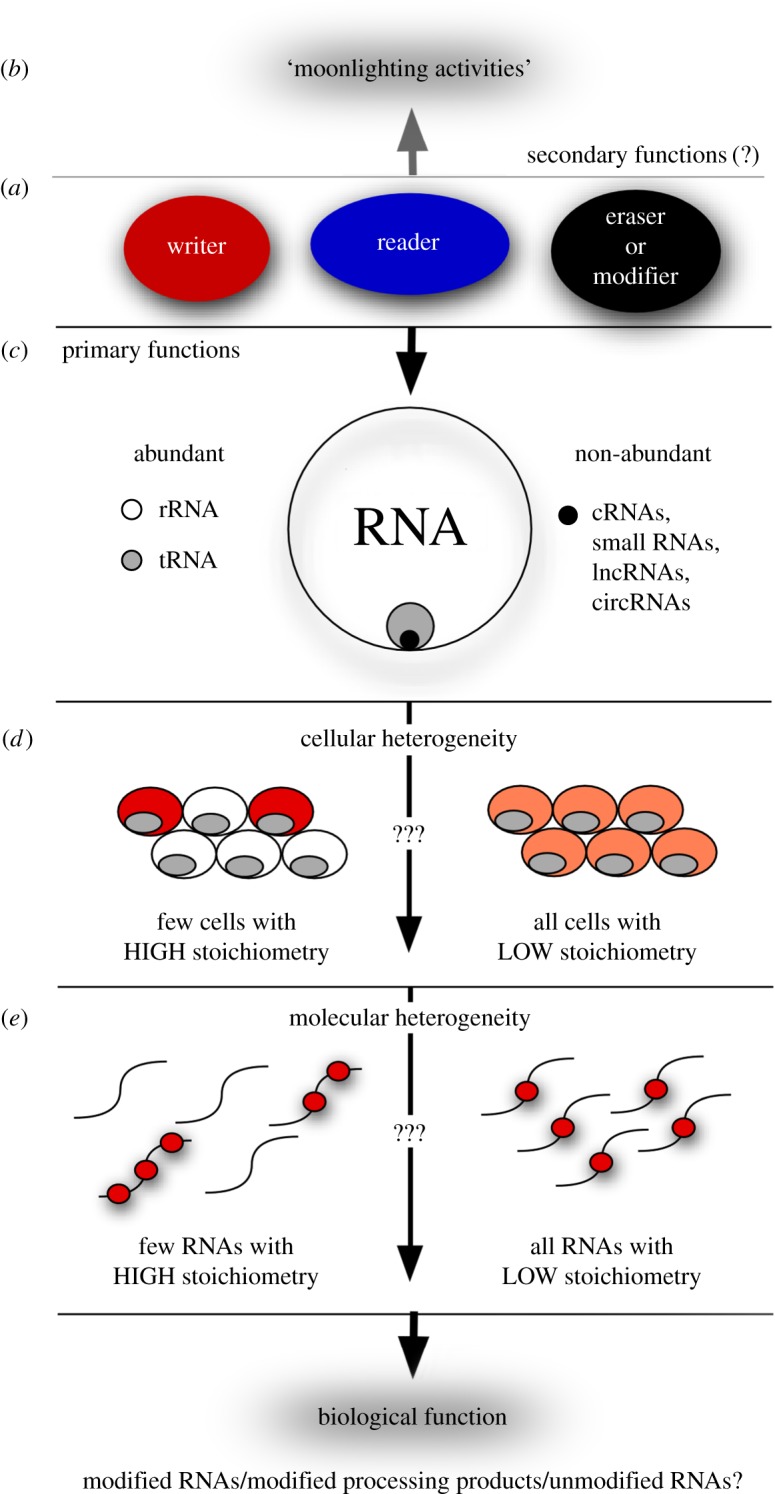
Where Modifications Change RNA Behavior
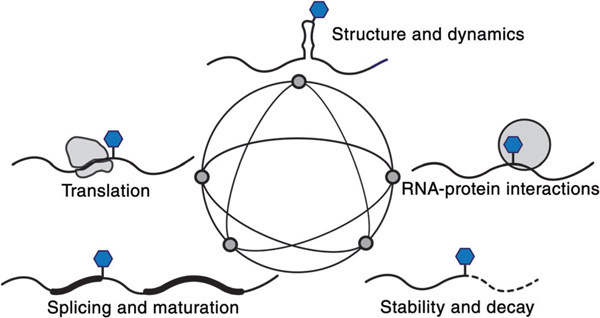
A modification can influence RNA at several levels, from molecular structure to transcript lifetime and interaction with the translation machinery.
Chemistry
Modification changes nucleotide properties.
Structure
Local folding and base pairing can change.
Recognition
RNA-binding proteins can respond differently.
Processing
Splicing, transport or stability may be affected.
Function
Cellular RNA behavior ultimately changes.
How Scientists Detect Modified RNA
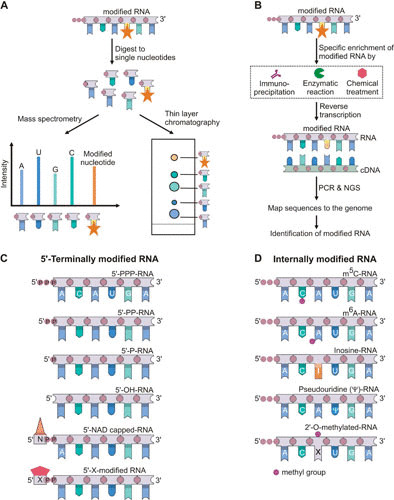
Detecting RNA modifications is technically challenging because modified nucleotides can be chemically similar to their unmodified counterparts. Researchers therefore combine biochemical, analytical and sequencing approaches.
Mass spectrometry
LC-MS and related approaches can identify modified ribonucleosides according to their mass and chemical properties.
Enrichment methods
Antibodies or chemical strategies can enrich RNA populations containing particular modifications before sequencing.
Sequencing approaches
Modification-sensitive sequencing can introduce characteristic signals, stops, mismatches or changes in read behavior.
From Chemical Marks to Molecular Maps
Once modifications are measured, the next challenge is to understand where they occur and how their distribution changes across transcripts, tissues, organisms or experimental conditions.
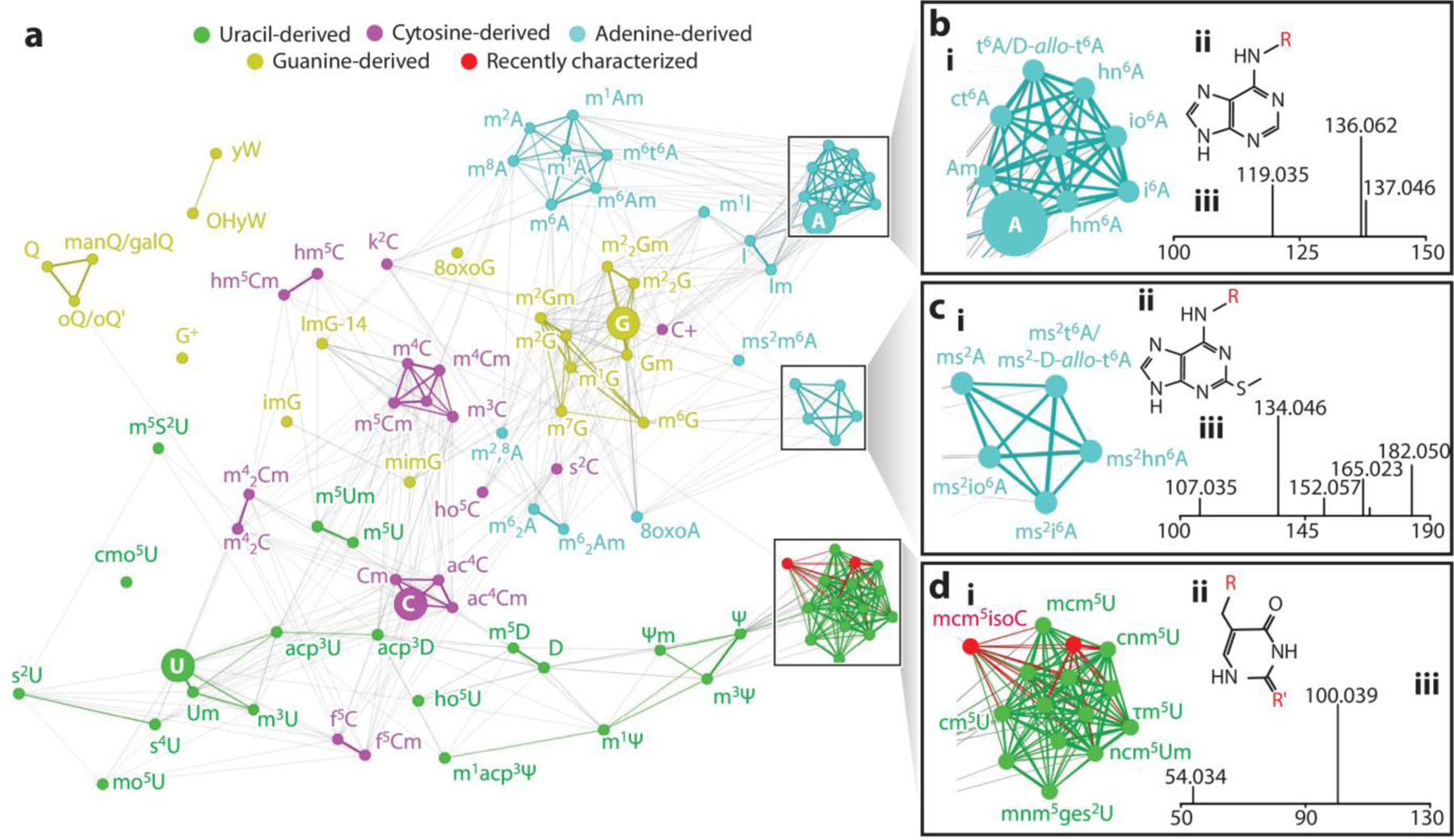
Mass spectral fingerprints
Mass spectrometry can generate characteristic signals for modified nucleosides and provide highly sensitive chemical measurements.
Pattern recognition
Computational systems can classify spectral patterns and support automated detection of modified nucleosides across large datasets.
The Challenge of Context and Resolution
Detecting a modification is only the beginning. Researchers must determine its position, abundance, chemical identity, transcript context and biological consequence.
| Question | Why it matters | Typical challenge |
|---|---|---|
| Where is the modification? | Position can determine its effect on RNA structure or recognition. | Transcriptome-wide methods may have limited site resolution. |
| How much RNA is modified? | Modification stoichiometry can influence biological interpretation. | Low-abundance modifications are difficult to quantify accurately. |
| Which RNA carries it? | mRNA, tRNA, rRNA and non-coding RNA have different functions. | Complex RNA populations can overlap analytically. |
| What does it do? | Presence does not automatically establish biological function. | Functional validation requires additional experiments. |
When Chemistry Meets RNA Structure
RNA modifications can change the chemical landscape of individual nucleotides and, in turn, influence folding, base pairing and molecular interactions.
RNA structure is not determined only by its nucleotide sequence. Chemical modifications can change the local properties of nucleotides and influence how RNA interacts with itself and with proteins.
This creates a close relationship between the sequence layer, the structural layer, and the chemical layer of RNA biology.
Sequence → Modification → Structure → Function
Modern RNA research increasingly studies these layers together rather than treating them as isolated molecular properties.
From Epitranscriptomics to Biotechnology
As researchers learn how RNA modifications influence molecular behavior, the epitranscriptome becomes increasingly relevant to RNA engineering, transcript design and analytical biotechnology.
Engineered transcripts
Understanding modification-dependent behavior can inform the design and optimization of synthetic RNA molecules.
RNA-based technologies
Modification chemistry is an important consideration when developing RNA-based research and therapeutic platforms.
RNA characterization
Advanced analytical methods enable increasingly detailed characterization of RNA composition and molecular quality.
Modification-aware analysis
New sequencing approaches aim to detect molecular signatures associated with RNA modifications.
Integrated datasets
Machine learning and computational analysis can connect modification patterns with sequence, structure and expression data.
Systems-level RNA biology
Combining multiple RNA layers creates a broader framework for studying dynamic molecular systems.
RNA as a Dynamic Molecular Code
The epitranscriptome demonstrates that RNA biology cannot always be understood from sequence alone. Molecular information emerges from several connected layers.
Sequence
Defines the nucleotide framework and biological information encoded by RNA.
Structure
Determines how RNA folds and presents molecular interaction surfaces.
Modification
Adds chemical information that can dynamically influence RNA behavior.
The future of RNA biology is increasingly multi-layered.
Sequence, structure, chemical modification, expression and cellular context are becoming interconnected components of the same biological information system.
Beyond the sequence, toward RNA systems.
The study of RNA modifications is transforming how scientists think about RNA information. By connecting chemical composition with sequence, structure and cellular context, epitranscriptomics provides another way to understand the dynamic behavior of RNA.
RNA is not simply a string of nucleotides. It is a dynamic molecular system whose behavior emerges from interacting layers of information.